The group and its entities
Who this page is for
For anyone who wants to understand how al-Shamil organizes its data: what belongs to the whole group, and what belongs to one entity — which explains why some windows ask you to select an entity and others never do.
The group: an independent database
A group is the books of one business: an independent database with its own members and subscription. Someone who belongs to several groups opens one at a time (Choosing the group), and no group ever sees another's data.
The entity: the fiscal unit inside the group
An entity is a business or branch that keeps its own books and periods inside the group. The accounting periods themselves belong to an entity: “Select an entity first: accounting periods belong to an entity.”
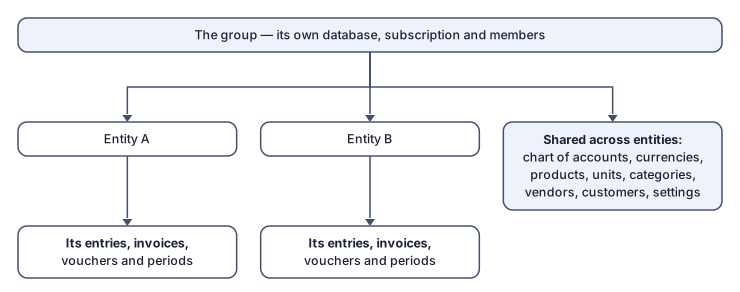
What the group holds falls into two halves:
| Belongs to the whole group (every entity shares it) | Belongs to one entity |
|---|---|
| The chart of accounts | Journal entries |
| The currencies, and the main currency | Purchase and sales invoices |
| Products, units and categories | Payment and receipt vouchers |
| Vendors, customers and their accounts | Accounting periods and fiscal years |
| The accounting settings, and the data languages | |
| The accounting level |
That is why the transaction and period windows work in the selected entity (Choosing the entity), while the master-data windows open with no entity at all.
What follows from this
- An entry in entity A never shows in entity B's general ledger, even though both book to the same account of the shared chart.
- Closing a period in one entity does not touch another entity's periods.
- Reports ask for the entity where it matters; the chart of accounts and the products are one for everybody.