Units
Who this page is for
Anyone managing “The units products are counted in: piece, box, kilogram…”. It opens from Master Data ← Units. It needs a group, no entity — units belong to the whole group.
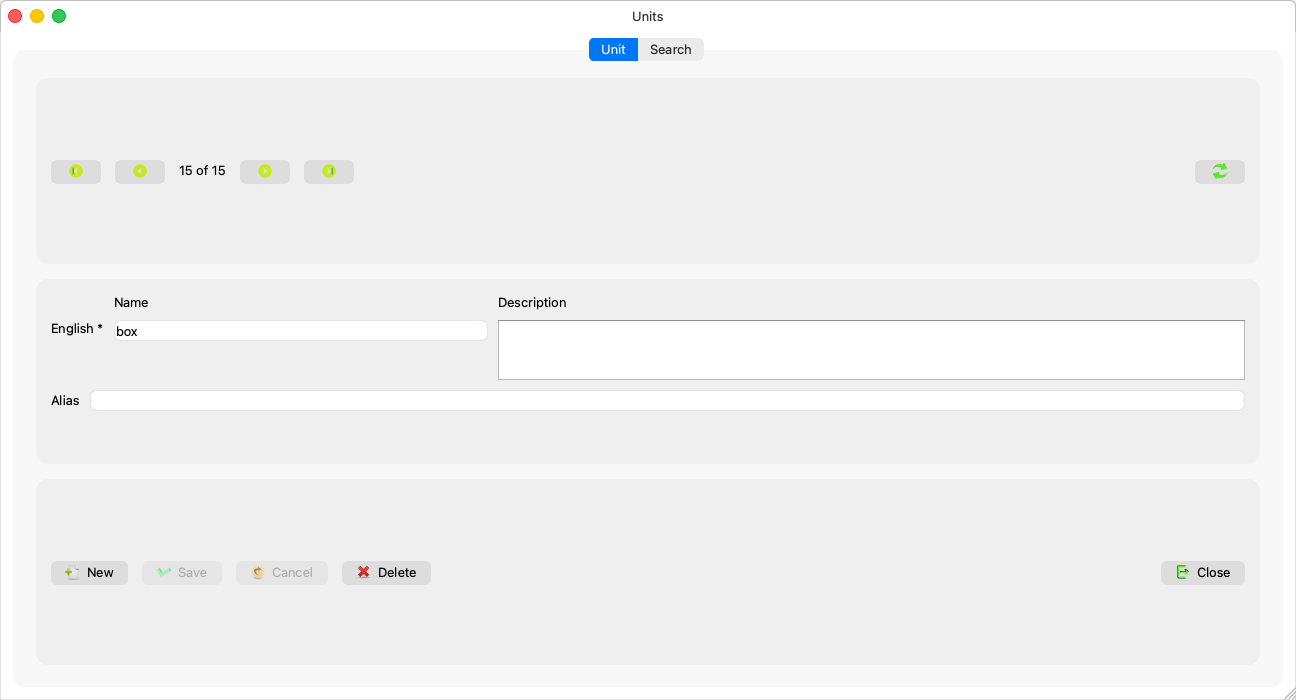
Names in the data languages
This is the first window where you meet translated names; the same rows appear in Products and Categories — the concept is in Data languages:
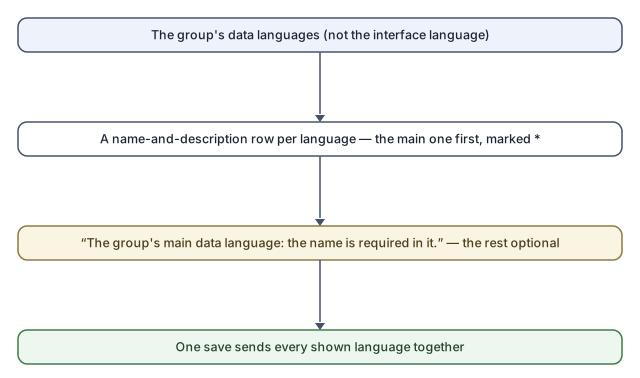
- Each of the group's data languages has a name-and-description
row — the main one first, marked
*: “The group's main data language: the name is required in it.” The rest are “Optional.” - The rows follow the group's languages, not your interface language: an Arabic-only group sees one row, and no English field anywhere.
- A missing name in the main language stops the save: “The name in the group's main data language cannot be empty.”
- Did an administrator change the group's languages while you worked? The rows are rebuilt for the new languages and your typing is kept: “The group's data languages have changed, and the fields now follow them. Enter the name in {language}, the group's main data language, and save again.” — and a dropped language's text stays to copy from: “No longer one of the group's languages: kept here to copy, never saved.”
Beside the names sit the alias (optional, language-free) and the description.
The Search tab
The familiar search tab: twenty results from the server (“Search a name in any language, or an alias”), and one name column per data language — an empty cell means no name in that language, so the gaps stay visible rather than papered over. The tab is disabled while the shown unit has changes: “Save or discard the current unit first, then search.”
Rules and refusals
-
Deleting a used unit is refused with a report of where it is used:
“This unit is still in use, so it cannot be deleted.” — “Where it is used:” prices, unit factors on products, the base unit of products, invoice lines — each with its count.
-
“No unit matches this search.” / “Showing the first {count} matches. Narrow the search to find the others.”
Common mistakes
- A unit per spelling (kg, kilo, kilogram) — one unit, with the variants in the alias.
- Naming it only in a non-main language: it will not save; the main language is the required one.